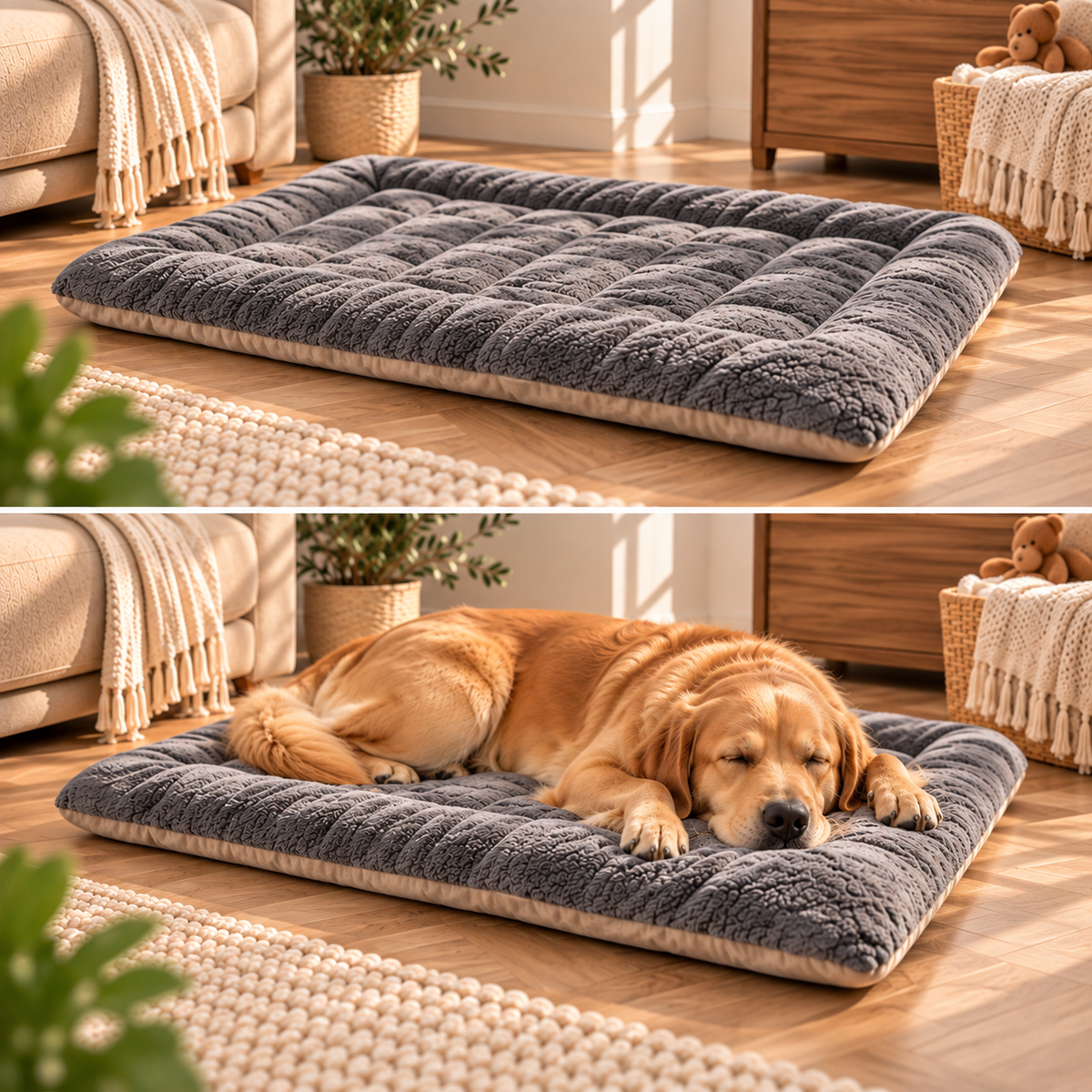
Yes, in most cases a dog bed should be a little bigger than your dog when they are lying down.
The goal is not to create a huge empty space. It is to give your dog enough room to rest naturally without their body constantly hanging over the edges.
How much bigger should the bed be?
A useful starting point is to measure your dog from nose to the base of the tail while they are lying down and then add around 15–25 cm.
That extra space allows for movement and gives your dog room to change position during sleep.
If you have already read our dog bed size guide, this is the same principle: measure the dog you actually have rather than buying on breed name alone.
What happens if a dog bed is too small?
A dog can still sleep in a bed that is slightly undersized, but it may not be their most comfortable option.
Signs the bed may be too small include your dog regularly hanging their head or back legs over the edge, repeatedly getting out and resettling, or choosing the floor instead when they want to stretch out.
Some dogs do deliberately drape themselves over the sides, so one behaviour on its own is not proof. Look at the overall pattern.
Can a dog bed be too big?
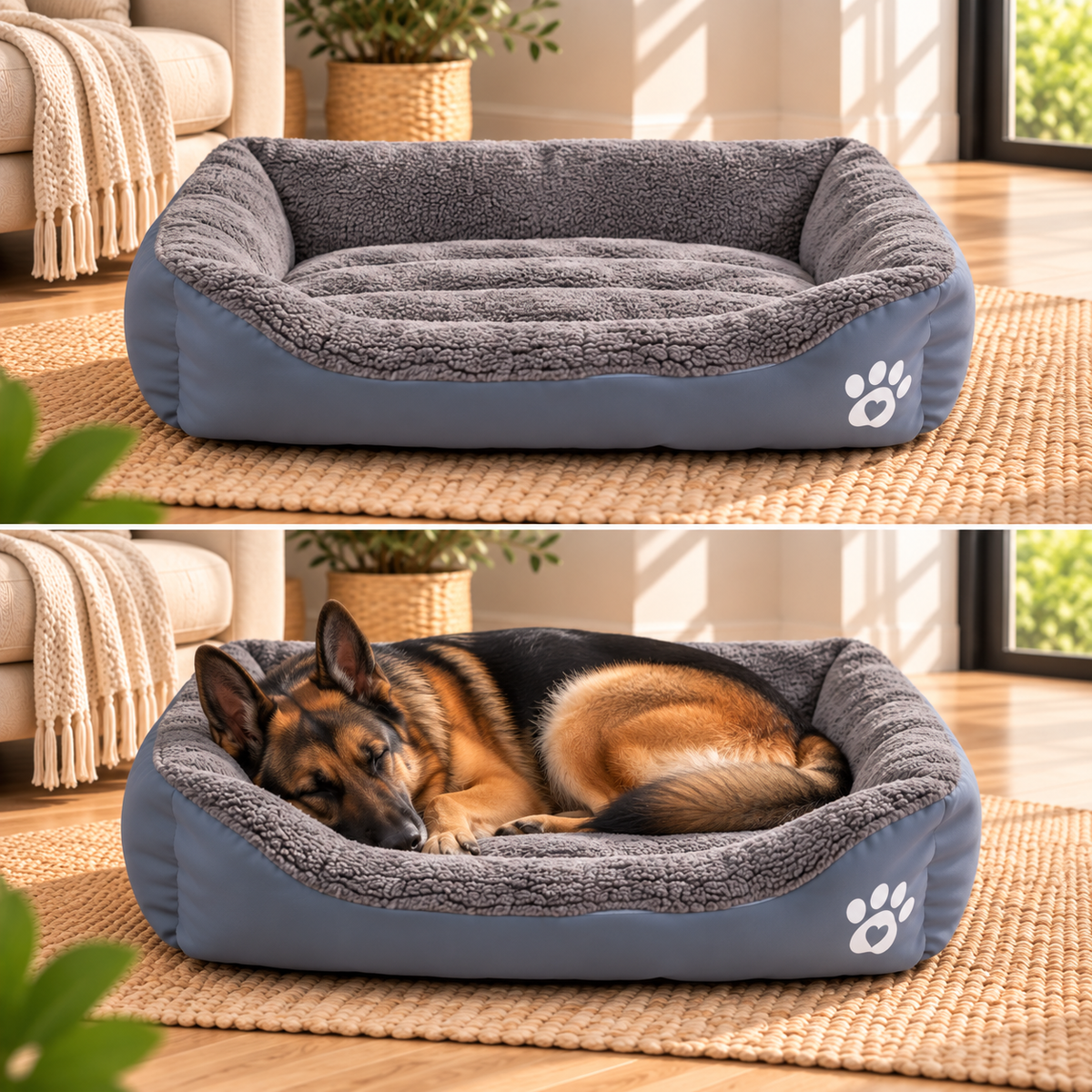
Yes, particularly for dogs that enjoy a cosy, enclosed feeling.
Some dogs naturally like to press against the side of a bed or curl into a compact shape. A very large open bed can feel less secure to them than a bed that fits their body more closely.
That is why the best answer is usually not 'buy the biggest size'. It is 'buy enough room for natural movement'.
Sleeping style matters
A curled sleeper can often be comfortable in a more compact bed. A dog that sprawls on their side or sleeps with legs fully extended will need more space.
If your dog moves between both positions, sizing up is usually the safer option.
Puppies and growing dogs
For puppies, consider how quickly they are likely to grow. Buying a bed that fits perfectly today may mean replacing it sooner than expected.
A slightly larger bed can be made cosier while your puppy grows by adding a familiar blanket or soft comfort companion.
Older dogs
Older dogs may benefit from additional room because turning, lowering themselves and getting back up can become more difficult with age.
If the choice is between a snug fit and a slightly roomier fit for an older dog, the roomier option is often more practical.
Measure the available space too
Before ordering, measure the area where the bed will go. A larger bed only works if it still fits comfortably in the room without blocking doors or creating an awkward walkway.
So, what is the best rule?
Aim for a bed that is larger than your dog's relaxed lying-down measurement, but not so oversized that it loses the sense of a defined sleeping space.
If you are choosing between two suitable sizes, the larger one is normally the safer choice.
Barklore's The Nest is available in multiple sizes and is designed for dogs that like having a soft, defined place to curl up or stretch out. You can also browse the full Rest & Comfort range for more wind-down options.


Leave a comment
This site is protected by hCaptcha and the hCaptcha Privacy Policy and Terms of Service apply.